Your program,
explained.
Kaha Trainer builds a strength program around your goal, your gym, your injuries and your week — and tells you why every exercise is in it.
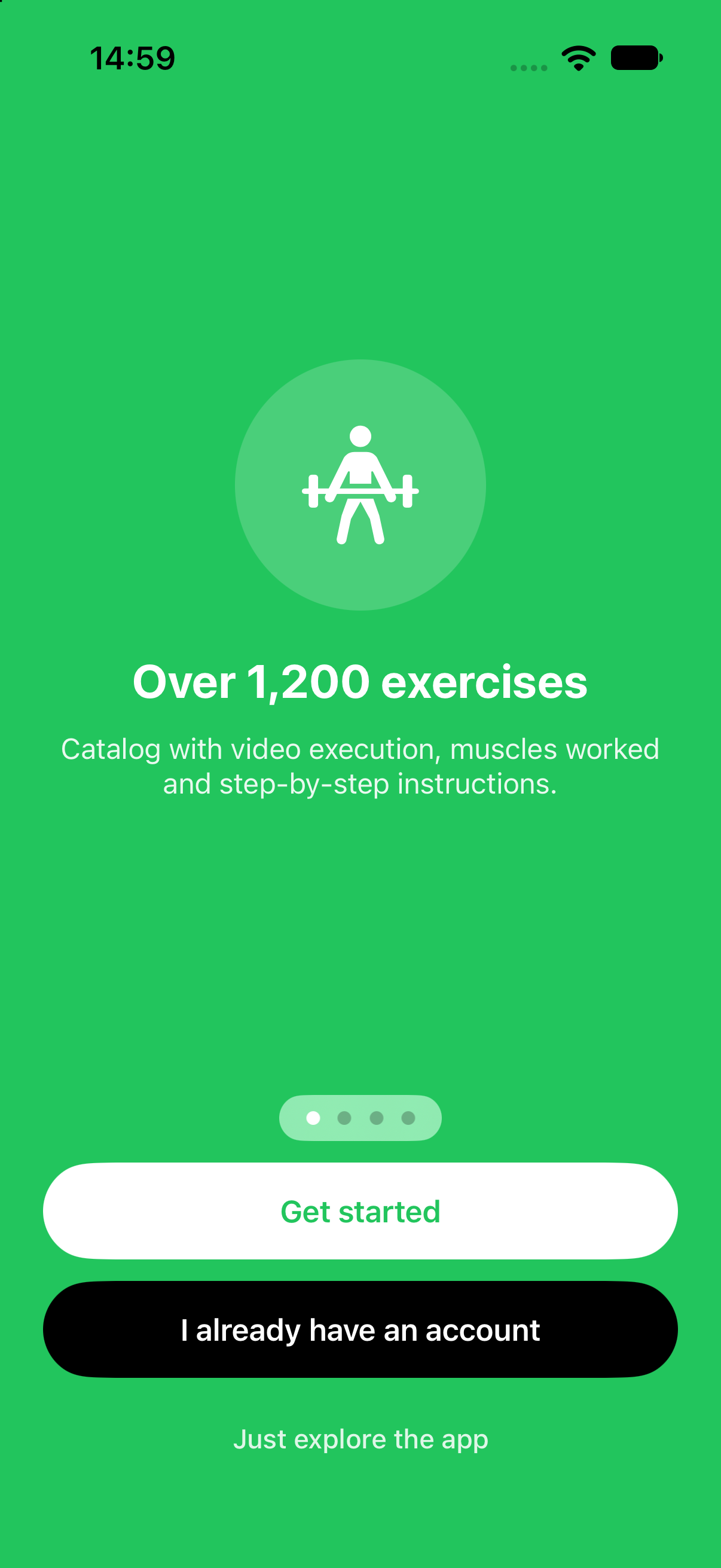
Kaha Trainer builds a strength program around your goal, your gym, your injuries and your week — and tells you why every exercise is in it.
Why another training app
A plan from a magazine, a PDF from a friend, a list generated by a chatbot — they all assume a gym you may not have, a body that never gets sore, and a week that never changes. Three things go wrong, every time.
Half the plan needs a cable machine. Your gym has two. You improvise, the stimulus changes, and nobody tells you whether the swap still works.
Adding load after a session where you missed reps on three sets isn't progression. It's debt — and it shows up two weeks later as a stall.
A plan that can't explain itself can't be corrected. Why squats, when you said your knee hurts? Silence isn't an answer.
How it works
Goal, experience, which gym you're training at, muscles you want to bring up, anything that hurts, how many days a week, how long a session can run, and which split you like. Under two minutes.
Exercises, sets, reps and rest for every training day — plus a plain-language note explaining why each choice was made and what was left out.
Warm-up sets computed from your working weight, a rest timer between sets, last session's numbers right under the exercise, and a load suggestion at the end — only when you earned it.
Features
Goal, experience level, session length, weekly frequency, split and rest days. Say a joint hurts and the exercises that load it are excluded — not buried lower in the list.
Register each gym you train at and what it actually has — machines, benches, racks, pull-up bars. The program only prescribes what you can load today.
Rest timer per exercise, warm-up sets rounded to real plates (2.5 kg or 5 lb), reps-in-reserve logging, exercise history and instructions one tab away.
Body weight, body-fat percentage and circumference per muscle group — left and right tracked separately. Volume per muscle, per week, per exercise.
Create a competition, share the code, set the scoring exercises, the rules and the prize. Live standings for everyone who joins.
Your program, history and measurements are cached on the device. The basement gym with no bars of service still opens to a full workout.
Inside the generator
Kaha Trainer doesn't ask a language model what you should train. It runs a set of rules over a catalog where every exercise carries a grade — per goal, per role, per prerequisite. Same answers, same program, every time.
That matters for one practical reason: a program that is reproducible is a program that can be argued with. If something looks wrong, there is an actual reason to point at.
Progression
At the end of a session, Kaha Trainer looks at what happened. Every working set completed, every rep target met, and reps still in reserve on the sets before the last one — then it suggests a heavier load, in a jump that fits the plates you have.
One set short of target and it says nothing. Progressing on an unmet goal is how a stall gets built.
Total volume lifted, workouts completed, calories burned — six tiers each, across your whole history.
Set how many sessions a week counts as a good week. The current week only breaks the streak once it's over, not while you're still in it.
Finished workouts go to Health with duration and energy. Height, age and body data come back to sharpen the calorie estimate — and when a number isn't known, the app shows a dash instead of guessing.
Privacy
Kaha Trainer is free and carries ads. That's the deal, and it's worth stating plainly rather than burying in a policy nobody opens.
Product analytics are tied to a random identifier generated on your device — not to your account, your email, or a single measurement you've logged.
No full-screen ad during an active workout, none over the rest timer, and none between finishing and seeing your summary. That's enforced in code, not by policy.
What the app reads from Apple Health is used on the device for calorie and body calculations. Your account stores what you choose to save in the app.
Full detail in the Privacy Policy and Your Privacy Choices.
FAQ
Yes. No subscription, no paid tier, no locked features. The app is supported by ads.
You can explore the app — the catalog, the screens, how it all works — without one. Creating a program, logging a workout or saving a measurement needs an account, because that data lives in the cloud so it survives a new phone. Sign up with an email address or with Sign in with Apple.
Not today. Kaha Trainer is an iPhone app, built with native iOS frameworks including Apple Health.
No — and that's a design decision, not a limitation. The program comes from explicit rules over a graded exercise catalog, which means the same answers always produce the same program and every choice can be traced to a reason.
Register the gym and check off what it has. The generator only prescribes exercises you can perform there, and you can keep more than one gym — home and commercial, for instance — and switch between them.
Yes. The assistant is one of two routes; the other is building from scratch, picking every exercise, set and rep yourself. You can also save your own training splits and reuse them.
English, Portuguese (Brazil) and Spanish — the whole interface, not just the menus. It follows your iPhone's language by default, and you can override it in the app.
Almost there
The app is finished and in review for release. Drop us a line and we'll tell you the day it goes live.
Email us at info@kahatrainer.com